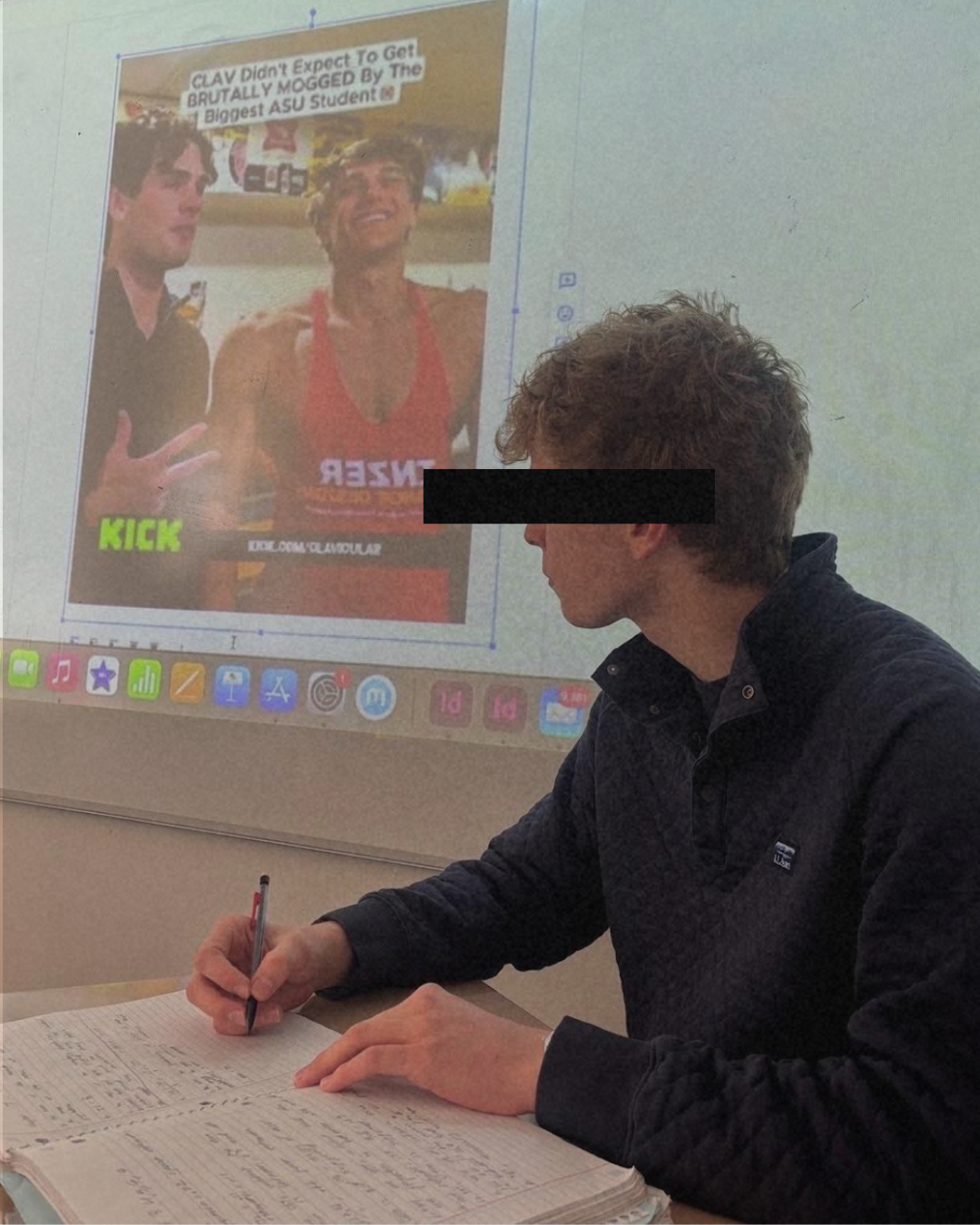
The Health and Wellness Club meeting was supposed to be about skin care: vitamins, hydration, maybe even sunscreen. But it was not. Within minutes, the conversation shifted. Students began sharing routines pulled straight from the internet: Zygopushing, which involves applying manual pressure to the zygomatic bones to encourage a more prominent midface; bone smashing, a controversial and risky technique of hitting your facial bones with a hammer to create micro-fractures which increase bone projection and density through remodeling; and peptides, short chains of amino acids to completely change the way one looks with no outside effort. While these niche techniques sound half scientific and half absurd, they were fully unignorable. What was supposed to be “skinmaxxing” quickly turned into a hardcore blackpill discussion. Blackpill, by the way, refers to the ideology that romantic success depends only on unchangeable physical features, which leads many young men to experiment with looksmaxxing.
Looksmaxxing had already made its way in. Outside its own corners of the internet, the backlash hit almost instantly. Scroll through posts or articles and you see the same labels thrown around – obsessive, toxic, dangerous. But reducing the movement to those words ignores what is actually happening, both online and in real life. Looksmaxxing, a collection of practices focused on completely improving male appearances, hasn’t become popular because it is uniquely extreme or profoundly dangerous, but because it taps into something familiar: the pressure to look better, because, many believe, with better looks comes better opportunities.
At the center of the movement, and on top of the looks hierarchy, sits Braden Peters, better known as Clavicular or Clav. His streams, hyper-focused on mogging and ascending, pull in massive audiences. Short, viral posts have pushed looksmaxxing to the mainstream. For those who do not know, the term “mog” is derived from the term “AMOG” or alpha male of the group. The action of mogging is to appear significantly more attractive than someone else, but now people can mog others in all aspects of life.
But Clavicular is a controversial figure. One moment in particular captures Clav’s personal controversy perfectly. Teaming up with a group of streamers, including the Tate brothers and Nick Fuentes, the so-called “Avengers” hit up a Miami nightclub and played Kanye West’s infamous antisemitic song. Additionally, Clav has been arrested many times across the country and is known for his misogynistic worldview.
Clav also draws a clear line between who does and does not belong in the looksmaxxing community. When a woman approached him with a question, he shut it down, saying, “It’s a male space, Ms. Kirk… My culture is not a costume” (New York Times). Interactions like these don’t just reflect on him; they shape how society perceives all looksmaxxers and moggers. For outsiders, Clav isn’t just a famous participant; he is the definition, the top mogger.
That belief that looksmaxxing is entirely a misogynistic movement, however, starts to fall apart when you look beyond figures like Clav. At SCH, and plenty of other places, students engage with looksmaxxing in diverse ways that are not always extreme. Some treat looksmaxxing culture as a joke, others as a way of life, but most people who are tapped in look at the looksmaxxing movement as a means to genuine self-improvement.
The same meeting that veered into extreme looks-enhancing techniques also carried a sense of curiosity and, obviously, a bold sense of humor. It wasn’t a room full of crazy boys, but a room filled with teenage boys experimenting with the new viral movement.
Then the unthinkable happened. The Frame Mogging of 2026. A viral moment that dethroned Clav as the top mogger, but actually pushed looksmaxxing further into everyone’s feed.
“On February 17, 2026, the world changed forever. Society will never be the same. Clavicular was brutally framed by the ASU (Arizona State University) Frat Leader. For a generation of larpmaxxing (live action role play maxxing) young men trying to ascend from Sub-Human to True Adam, this is life-shattering. I am devoting my life to make sure the next generation can jestermax without the constant fear of being mogged by frat leaders,” said one student.
For many people, that appeal is straightforward. As one student put it, “It is clear that in society, you have better opportunities the more attractive you are. So why not capitalize on this, ascend, and live a better life?” This logic is not new. What’s new is how explicitly it’s discussed, quantified, and shared.
None of this means the movement is harmless. Critics point to real concerns such as body dysmorphia, use of unsafe and unresearched chemicals, and communities slipping into misogyny and resentment of women.
Clav himself embodies this tension. As The New York Times noted, “Clavicular seems as much as anything a calculating product of a hyperactive digital community that rewards violation of taboo.”
And while some effects are harmless or even positive, the line between self-improvement and self-destruction can blur quickly. At its worst, looksmaxxing turns improvement into obsession, and natural looks into self-worth. But focusing only on those extremes flattens the bigger picture. Many participants engage with looksmaxxing casually and safely, just like any other form of self-care. That nuance often gets lost, especially when the most visible figures are the most controversial.
More important than the controversy surrounding members of the community is the way it overlooks how similar looksmaxxing is to other forms of self-harm. That tension revealed itself in a Moment of Understanding session called Bodies! Bodies! Bodies! Many went in expecting a discussion on Clav and newfound male beauty obsessions, but the lesson instead focused on women’s body image — the pressures and comparisons women have been navigating for thousands of years. The session highlighted a stark contrast: while male appearance obsession sparks moral panic, female-focused body work has been normalized and even celebrated for generations. The techniques differ, and the scrutiny differs, but the underlying pressure is similar.
That difference in reaction raises a larger question. For generations, people have encouraged women to optimize their appearance through makeup, skincare, dieting, and even cosmetic procedures. These practices easily become consuming and dangerous, and while many people do speak out against their harmfulness, society seems to accept the consequences of these practices, which include severe bodily harm, depression, and sometimes suicide. On the other hand, looksmaxxing is always gross, dangerous, and misogynistic. The contrast is hard to ignore. When boys engage in similar behavior as girls, it suddenly becomes something new, something dangerous, something worth labeling as dangerous and then dismissing.
The real story in schools, and in the wider cultural movement, is about balance and context. Students have always been navigating social pressures and experimenting with self-image, but now online communities offer fast escapes from reality. Unfortunately for many, lots of these communities are rooted in deep resentment toward others, which can be found in the depths of online forums. One wise student put it like this: “It is one thing to take care of yourself; it’s another to let it consume your sense of worth.”
In the end, looksmaxxing isn’t really about jawlines or supplements. It is about control — who has it, who doesn’t, and how far people will go to feel like they’re in control. The backlash treats it like something new and crazy, but if you strip the jargon, it looks familiar. For years, appearance has shaped confidence and identity; this is just a loud response shaped by that pressure. While some hate on looksmaxxing and celebrate female beauty practices, they are two wings of the same bird. The difference now is how fast looksmaxxing is spreading, how extreme it gets, and how easily it turns self-improvement into self-destruction. So the next time you hear someone quickly label looksmaxxing as a new and crazy phenomenon, enlighten them. While the rhetoric and the faces are new and absurd, looksmaxxing is neither new nor crazy. Looksmaxxing is really just a rebranding of practices, both safe and dangerous, that have been normalized for women for so long.