












































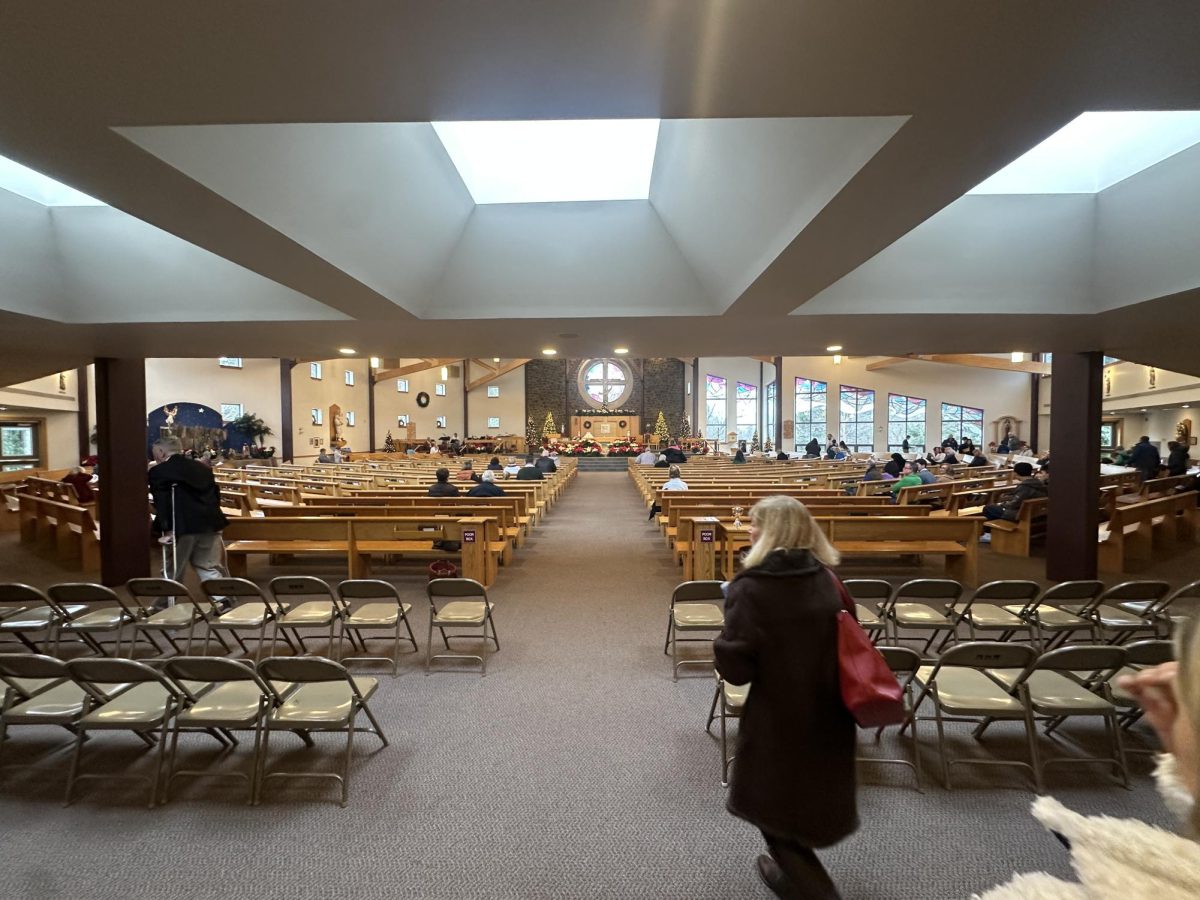
Every year on Christmas Eve my family and I head to mass before we go to my uncle’s for our annual Christmas party. We always show up thirty minutes early because the church fills up so quickly to the point that if you show up 30 minutes before the service starts, you will not have a seat. As I sit in the pew waiting, I often look around the church and see familiar faces and people smiling. Everyone is happy and excited for Christmas. If only every Sunday people came to church so excited.
A common joke among Catholics is that Christmas and Easter are one of the only days most Catholics go to church all year. But why is it like this? For many churches the majority of people coming to mass every Sunday are retired elders. While their presence is vital, the age imbalance suggests that teens may be disconnected from the church at the moment. According to the Pew Research Organization, “Nearly 6/10 Catholic adults are ages 50 and older.” This is a problem, and the reason why is because young people are the future of the church. Without the church — which is more than just a building with a cross on top, but a gathering of people who keep religion alive — the teachings of Jesus will slowly be forgotten. I believe older people feel more obligated and inclined to go to church because they have more reasons to – the biggest one being that they are closer to death.
Young Catholics often put off their religious obligations because they believe participation in the religion only matters when you are closer to death and have to prepare yourself for Heaven and judgement day. Additionally, among teenagers, religion isn’t the coolest thing to be involved in, which dissuades a lot of teens from participating. Many teens identify as Christian, but do not actually participate in their faith. A Pew Research Organization poll found that nearly 50% of US Catholics said that religion is important in their life, but only 30% said they go to mass weekly or frequently.
For Mrs. Lisa Bull, Director of Youth Faith Formation for Mary Mother of the Redeemer Church (MMR), part of her job working with young Catholics is to “try and encourage and help them grow in their faith.” Mrs. Bull has been working at MMR school and church in North Wales, PA for numerous years now, and has watched the religious development of thousands of students. From my lived experience, as a former student of hers, I can confidently say that her encouragement and teaching is part of the reason why I have continued my faith into high school. Despite my experiences feeling a lack of teen participation in the church, Mrs Bull is very optimistic for the next generation of Christians. “From my perspective, I think the teens are alive and on fire for Jesus Christ!” she said.
Similar to Mrs. Bull’s optimism, Father Conrad Murphy, a university chaplain at the University of Maryland, is also very hopeful in the next generation of Christians. He saw more student conversions to Catholicism this year than any other year in the past 15 years. Father Murphy observed that in generations prior, parents felt more obligated to have their families show up to church every Sunday, but as time has passed, parents have cared less and less. This results in less teens being able to practice their faith at mass every Sunday. However, the reason that Father Murphy is seeing a surge of faith in college students is because at college students are free to make their own decisions, including choosing to participate in any faith they want, and to make time for God. College is commonly known as a place of character development, and it seems that today it is encouraging spiritual development as well.
Part of the reason why there seems to be conflicting ideas, whether religion is booming or dying among young people is because it seems there is a silent digital-age movement of religion taking place. Young people are finding God in unconventional places that are not seen from the surface level.
Hannah commented on this very interesting trend that younger people are seeking answers, religious and non-religious, from ChatGPT. Instead of asking questions to their parents or a religious member they are finding them from an ai bot. This is a major reason why I think the religious boom is going under the radar.
While some may say it is bad that younger people are not going to the church for their answers, I think to have younger people seeking out religious answers for the adversities they face from any source is a step on the right track. For me personally, something that reintegrated me back into my religion was the state of the world the past couple of years. Right now, Americans are split economically, politically, and religiously which has caused it to seem like the world is ending. Through my worries for the future I have found my religion to help ground me and the moment and dismiss my fears. I think it is common for a lot of people to find Jesus again in times of adversity. “I experienced a house fire in seventh grade, and that was definitely a point that pushed me to be closer to [God], and to seek him out for answers and for help in that time,” commented Hannah Burke. Hannah has experienced one of the greatest fears of many, a house fire, which she said, ultimately brought her closer to God. Since that point, Hannah said, it has reminded her that at any moment everything can go wrong, but the one thing that will never be lost for Christians is God’s support.
Christian or not, having faith in something greater than yourself and monetary value is a way we all can find light in even the darkest moments. Mrs. Bull noted, “the Holy Spirit is with us always. He will assist you in becoming a disciple of Christ.” God cannot burn up in a house fire.
Even though I may be one of the only one of my friends that attends my church every Sunday, this does not mean young people as a whole have lost faith, it just means they may be waiting for that moment to come back to their faith or they are finding God in quiet ways.